Visual artwork · 2026
L’Univers dans l’ampoule
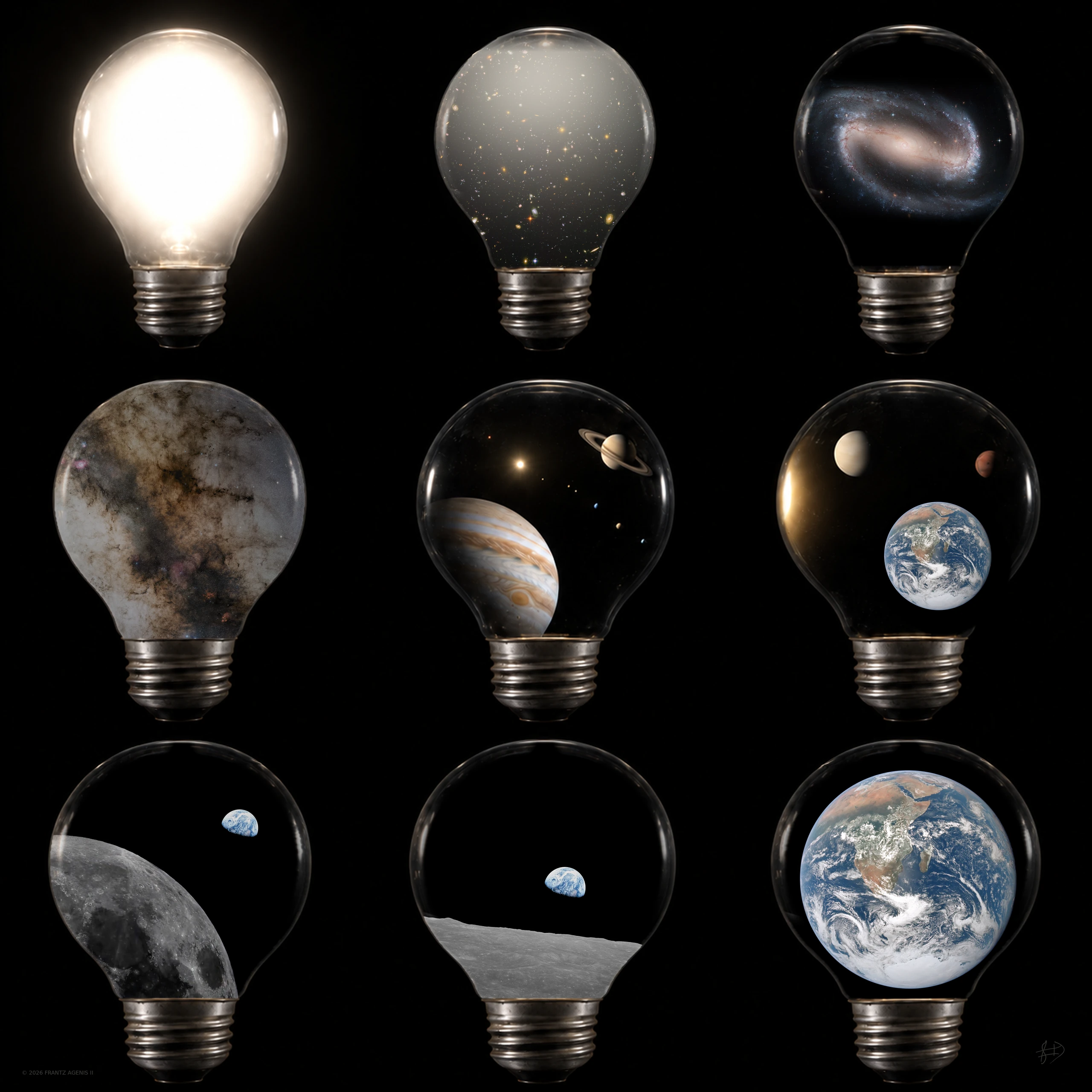
Source photographs: Image courtesy of the Earth Science and Remote Sensing Unit, NASA Johnson Space Center ; NASA (Apollo 8) ; NASA/Goddard Space Flight Center/Arizona State University ; NASA, ESA, and S. Beckwith (STScI) and the HUDF Team ; NASA, ESA, and The Hubble Heritage Team (STScI/AURA); Acknowledgment: P. Knezek (WIYN) ; ESO/S. Guisard (www.eso.org/~sguisard).
Photographs adapted for this composition. ESA/Hubble and ESO photographs: CC BY 4.0.
Less light, more to see.
A bulb shines so brightly that its contents become indistinguishable. As the glare fades, shapes, distances and worlds emerge. The sequence turns a reduction in light into a gain in perception: what once filled the gaze recedes, allowing what it concealed to become visible.
The glass and screw base give familiar proportions to an immense space. The object seems small enough to hold in one hand, while its interior opens onto a depth far beyond its scale. Realism makes this contradiction tangible, inviting a closer look at something we thought we knew.
The final two scenes bring the journey back to Earth. Above the lunar horizon, our planet becomes a small, suspended world seen from elsewhere. Then it draws closer: clouds, oceans and land become recognisable. The first bulb offered light with almost no distinctions; the last reveals a particular world. Crossing that immensity leads us to reconsider what it means to live here.
Request a reproduction quoteFor publication, a print or a collaboration.
Credits, sources and creation
- Artist
- FRANTZ AGENIS II
- Concept & direction
- FRANTZ AGENIS II
- Creation
- Digital composition combining astronomical photographs and LRO data.
- Signature
- Personal FAII signature, discreetly integrated into the image.
© 2026 FRANTZ AGENIS II for the composition and artistic contributions. Source photographs retain their respective credits. Permission requests.
Source photographs and data
- Apollo 17Image courtesy of the Earth Science and Remote Sensing Unit, NASA Johnson Space Center
- Apollo 8NASA (Apollo 8)
- Lunar Reconnaissance OrbiterNASA/Goddard Space Flight Center/Arizona State University
- Hubble Ultra Deep FieldNASA, ESA, and S. Beckwith (STScI) and the HUDF Team
- NGC 1300NASA, ESA, and The Hubble Heritage Team (STScI/AURA); Acknowledgment: P. Knezek (WIYN)
- GigaGalaxy ZoomESO/S. Guisard (www.eso.org/~sguisard)
Sources were cropped, resized and adjusted in luminance and colour, then composited inside the bulbs. Scales are artistic: the sequence does not represent a continuous astronomical zoom.
ESA/Hubble and ESO photographs licensed under CC BY 4.0.